


LIFE CLEAN-AIR Newsletter — July 2026
Vilnius pilot: forecasting ahead of the smog
Quantile forecasting is now live in Vilnius
Since 18 May 2026, the LLULL ENVIRONMENT platform — developed by INVERENCE for the LIFE CLEAN-AIR project (Call LIFE-2024-SAP-ENV, Environmental Governance) — has been running in full operational mode in Vilnius. It generates probabilistic pollutant forecasts, not single-point predictions but full uncertainty ranges, for NO₂, O₃, PM10 and PM2.5. This quantile-forecasting capability already goes beyond what most comparable air quality systems offer today, and is a first concrete milestone toward the technical deployment targeted under WP3.
Case in point: catching an ozone episode two days out
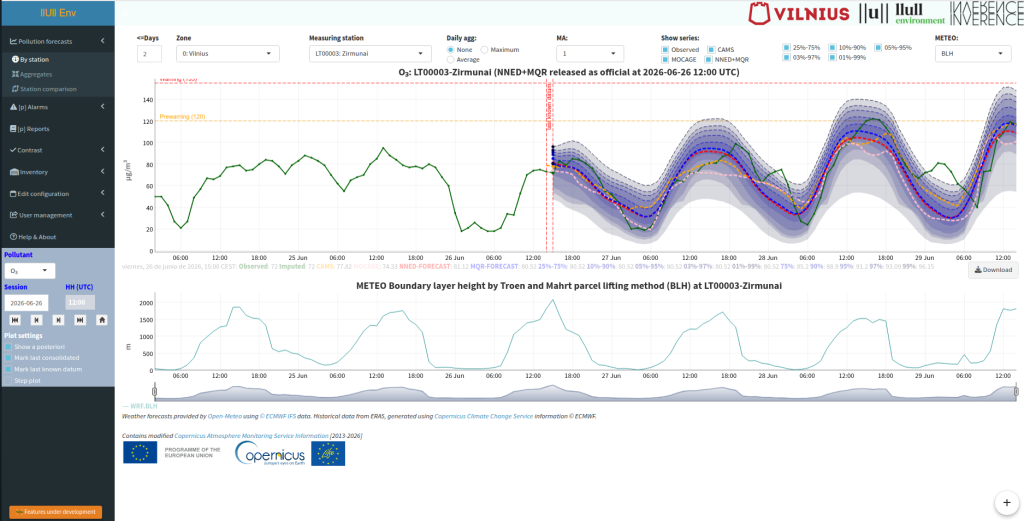
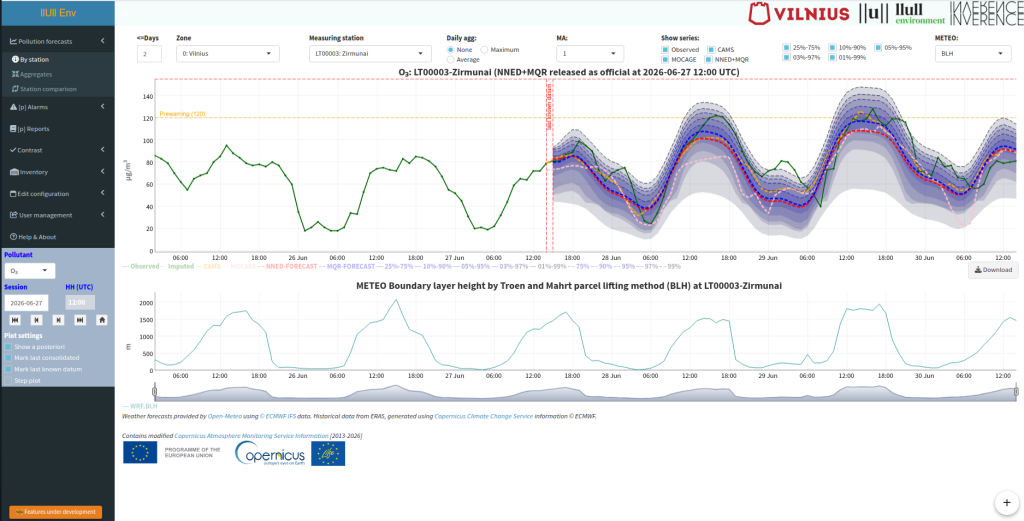
On 28–29 June 2026, ozone levels at the Žirmūnai monitoring station in Vilnius approached the EU pre-warning threshold (120 µg/m³). The charts below show what the system forecasted before it happened:
Both forecasts correctly anticipated the shape and timing of the rise well in advance, with the uncertainty band tightening — and the forecast sharpening — as the event drew closer. This is exactly the behaviour a well-calibrated early-warning system should show: a confident, useful signal days ahead, and increasing precision as the moment approaches.
What’s next
The pilot’s core commitment — turning these pollutant forecasts into actionable alarm probabilities and forecasted Air Quality Index (AQI) values for Vilnius citizens and authorities — is currently in development. These will complete the link between prediction and the voluntary Air Quality Plan (AQP) that Vilnius is targeting within the project’s first year.
LIFE CLEAN-AIR is co-funded by the LIFE Programme of the European Union. Contains modified Copernicus Atmosphere Monitoring Service Information [2013-2026].

